Capability 01 · Compliance
Turn completion records into audit-ready evidence.
Most systems record who completed what. Qaliber begins with the obligations your organization is required to meet, and ends with the evidence an auditor asks for — approvals, versions, identities and timestamps included.
The problem
Completion is not compliance. A tick with no approved content, no confirmed identity and no timestamp is an unsupported claim.
Compared
What you get elsewhere, and what you get here.
What you get elsewhere
- A due date, a completion flag and a reminder email.
- You supply the list of requirements, the mapping, and the evidence.
- A regulation changes, someone has to notice, and the matrix is rebuilt by hand.
- Falling out of compliance appears in next month's report, if anyone runs it.
- Retention is a folder policy. Legal holds are an email to IT.
What you get from Qaliber
- The requirements arrive with the system. You confirm them against your operation instead of building them from nothing.
- Obligations map to requirements, and assignments follow from job title, prior training and team.
- When a requirement changes, everything beneath it updates on its own.
- Falling out of compliance opens remediation immediately — an active route back, tracked in stages — not a flag at the next reporting cycle.
- Retention runs on policy, and legal holds override it. Versions, approvals and access records are kept for the audit rather than assembled for it.
Shown
See it working.
CitationIssuing bodyJurisdiction
29 CFR 1910.178(l)
Occupational Safety and Health Administration
federal
29 CFR 1910.178(l)
Powered Industrial Truck Operator Training
Scope and applicability
The requirements apply to all industries in which powered industrial trucks are being used, except agricultural operations.
Only trained and competent operators shall be permitted to operate a powered industrial truck.
Training program implementation
The employer shall ensure that each powered industrial truck operator is competent to operate a truck safely.
ApproveReject
Scanning…
Qaliber scans the citation, structures it, and puts it in front of a person to Approve or Reject. You are confirming a requirement against your operation rather than building one from a blank page.
From the product
The screens your team would work in.
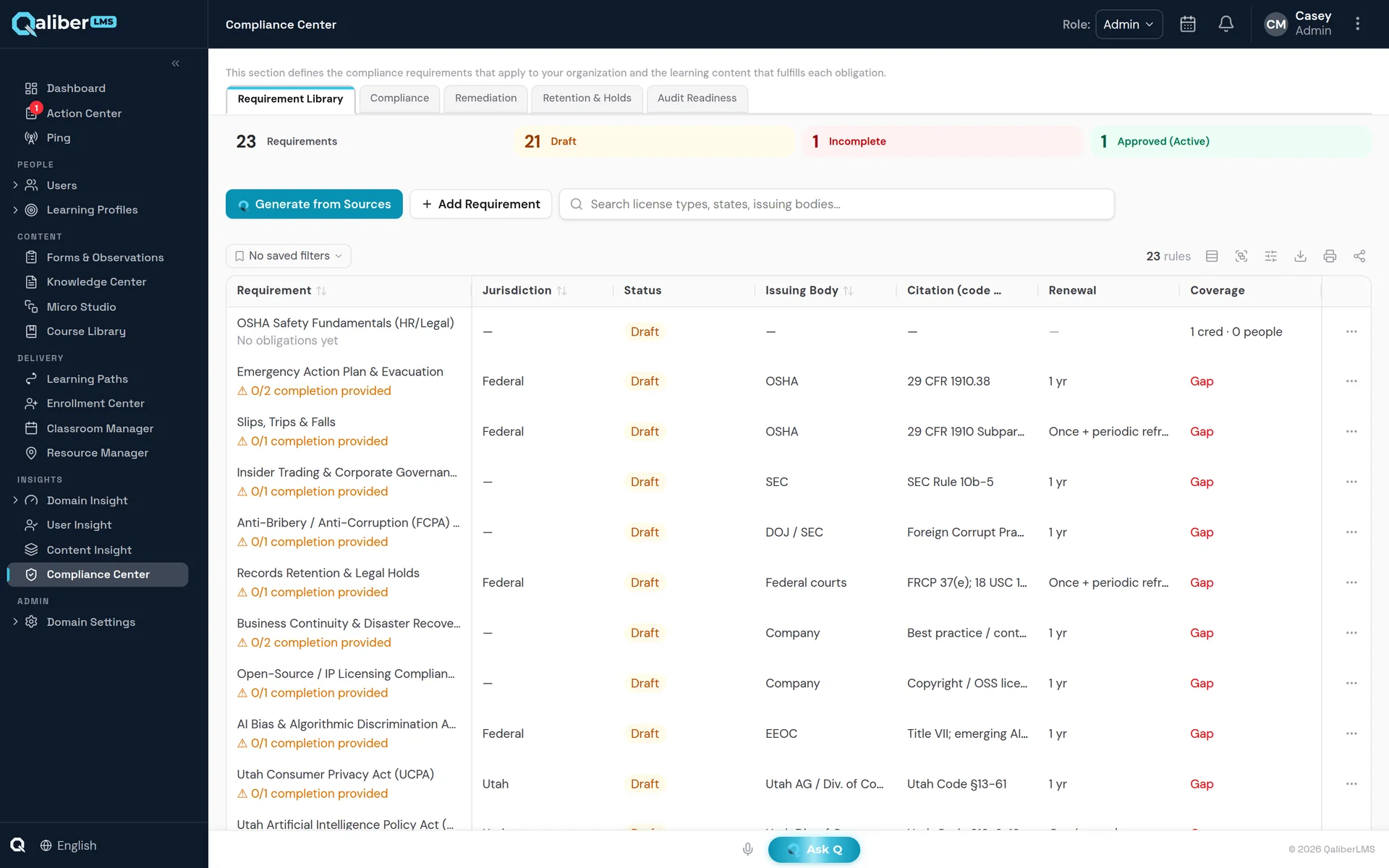
The Requirement Library — citation-level requirements with jurisdictions, issuing bodies, renewal cycles and coverage.
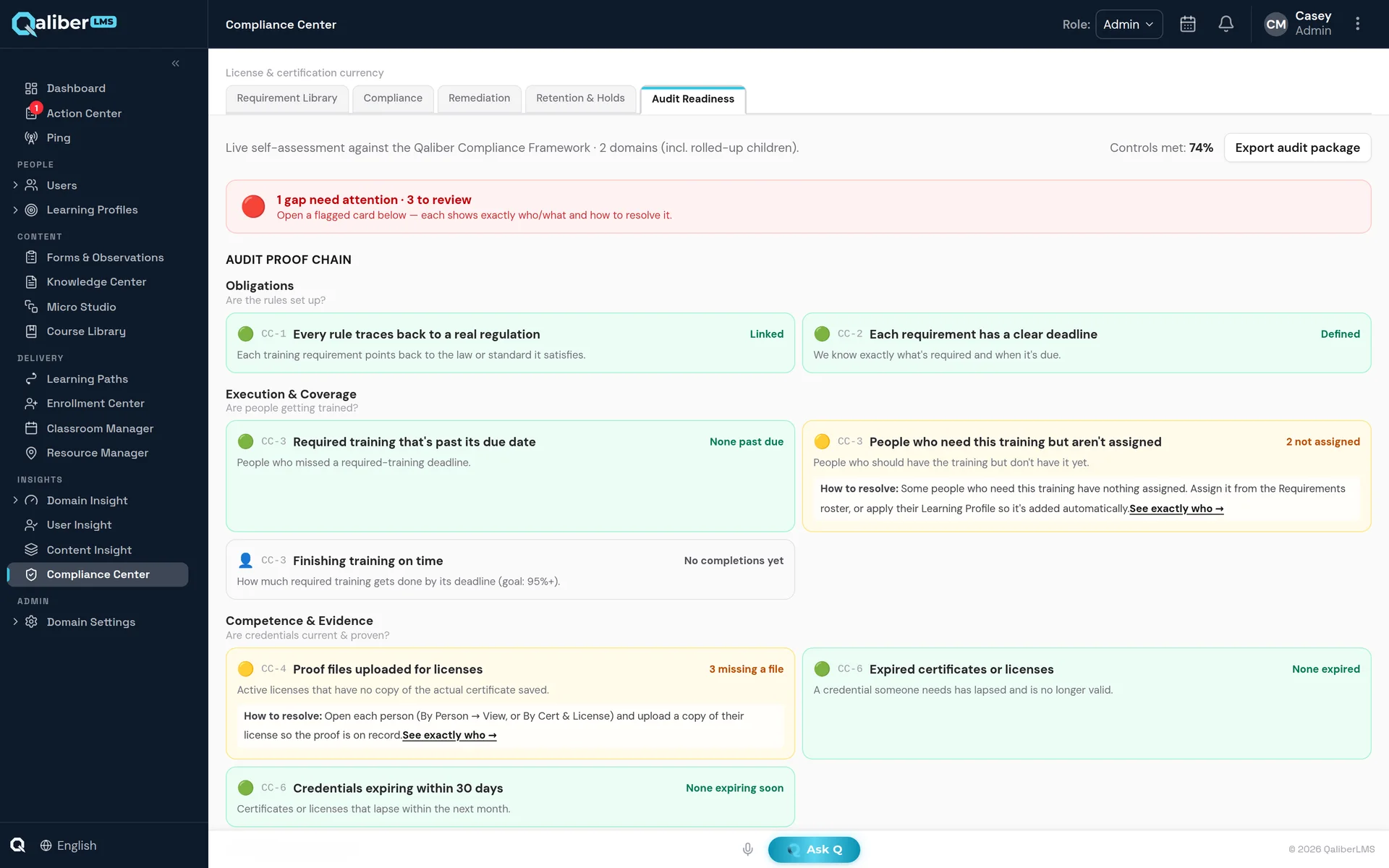
The audit readiness self-assessment, with the audit package one click away.
Included
What's included.
The requirements, already there
Start from a scanned, structured citation rather than a blank matrix. Confirm what applies to you and skip the six-week build.
A requirement, and the obligations under it
Each obligation is satisfied in its own way — training, an observed action, or acknowledging a policy — and every one must be met before the requirement is.
Build what satisfies it, in the same place
Courses, forms and documents are created inside the system, against the obligation they answer.
Assignment without administration
Rules read job title, training history and team, then assign accordingly, so a new hire, a change of role or a new site is handled in the same way.
Remediation when someone falls out
Falling out of compliance opens remediation — an active route back, tracked in stages, rather than a flag on a report.
Ready for an audit
Pull the record with its access history already attached, rather than assembling it once the request arrives.